


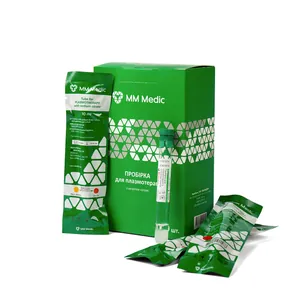
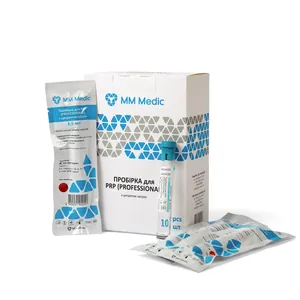
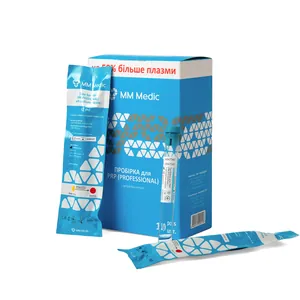
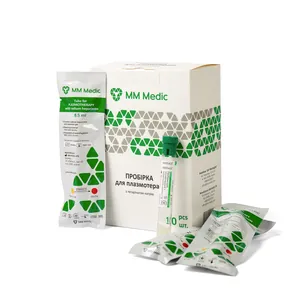
Tubes for obtaining fibrin PRF, 10ml
Vacuum glass tube for PRF. No anticoagulants, 0.6% siliconization. Creates dense fibrin scaffold for surgical applications, dentistry, wound healing.
Class IIa medical device
Not a laboratory tube. Certified for therapeutic use (ISO 13485). The cost difference compared to laboratory tubes is less than 2% of the procedure price. Why does this matter?
Unit of measure:
pkg.
Volume:
10 ml
Purpose:
PRF solid
Anticoagulant:
None
Medical devices are intended for use by qualified healthcare professionals in accordance with the manufacturer's instructions. The information on the website is for informational purposes only and does not replace medical consultation. More details
Certified. Products have undergone the conformity assessment in accordance with the Technical Regulation on Medical Devices (CMU Resolution No. 753). ISO 13485:2016 quality management system. View certificates
Natural fibrin formation in medical glass
Medical glass provides natural coagulation activation allowing to obtain dense PRF clot or membrane for surgical use. Without any chemical anticoagulants — only natural blood properties.
Key characteristics
- Final product
- Cell-rich fibrin
- Tube material
- Medical glass
- Anticoagulant
- None
- Separation gel
- No
- Blood draw volume
- 10 ml

How it works
PRF (Platelet-Rich Fibrin) — concentrate of autologous platelets, leukocytes and growth factors captured in dense fibrin matrix. Unlike PRP where blood remains liquid thanks to anticoagulant, PRF forms through controlled blood coagulation.
PRF technology principle
Fibrin matrix provides slow, prolonged growth factor release for 7-14 days, unlike one-time release when using liquid PRP.
Medical glass role
Glass is natural coagulation activator — this is key feature of PRF tubes. Controlled fibrin matrix formation ensures uniform cell distribution in clot.
Why without anticoagulant?
Anticoagulant blocks blood coagulation — exactly what needed for PRF formation. Absence of anticoagulant is mandatory condition.
What you will get
Final product characteristics
Dense yellow-white clot (after compression — a membrane), three-dimensional fibrin matrix, approximately 2–3 cm long.
Biological activity
PRF matrix contains and gradually releases:
| Shape | Application |
|---|---|
| PRF clot | Bone defect filling, sockets |
| PRF membrane | Wound covering, GBR, GTR |
| PRF crumb (plug) | Mixing with bone material |
| Sticky bone | Augmentation, sinus lift |
Usage time
PRF clot should be used within 30 minutes after centrifugation while fibrin matrix maintains optimal consistency and biological activity.
| Period | Activity |
|---|---|
| Day 1-3 | Initial release, regeneration launch |
| Day 4-7 | Peak growth factor release |
| Day 8-14 | Gradual decrease, tissue integration |
Advantage over PRP
Prolonged release provides sustained regeneration stimulation for 10-14 days, unlike one-time release with PRP injection.
Clinical application
Glass PRF tube intended for surgical interventions where biologically active material needed for filling or covering.
| Direction | Indications |
|---|---|
| Dentistry / Implantology | Socket preservation after extraction, implant osseointegration acceleration, peri-implantitis treatment, sinus lift |
| Maxillofacial surgery | Alveolar ridge augmentation, GBR (guided bone regeneration), GTR (guided tissue regeneration), oroantral communication closure |
| Periodontology | Gum recession treatment, furcation defect closure, periodontal tissue regeneration |
| Orthopedics / Traumatology | Fracture union stimulation, non-union treatment, cartilage regeneration |
| Surgery | Wound healing acceleration, chronic ulcer treatment, donor site covering |
| Plastic surgery | Graft support, post-operative wound healing improvement |
Best suited for
Surgical interventions where biologically active material needed for filling or covering; bone regeneration and augmentation; cases where mechanical strength important and surgical manipulation possibility; combination with bone substitutes (sticky bone).
Why choose this tube
Medical glass
Activates coagulation for dense PRF clot formation with high mechanical strength.
Controlled fibrin formation
Optimal process of quality fibrin matrix formation with uniform cell distribution.
Without anticoagulant
Natural coagulation with complete biological activity and growth factor preservation.
Product versatility
Clot, membrane, crumb or sticky bone — different forms for different clinical needs.
Prolonged release
Growth factors work 10-14 days, providing sustained regeneration stimulation.
Mechanical strength
PRF withstands surgical manipulation, suture fixation and mechanical load.
Centrifugation protocol recommendations
| Protocol | Result |
|---|---|
| L-PRF (Choukroun) | Standard speed, 12 min — dense clot, rich in platelets |
| A-PRF | Reduced speed, 14 min — softer clot, more leukocytes |
| A-PRF+ | Minimum speed, 8 min — optimized cell distribution |
Choose protocol depending on clinical situation and centrifuge manufacturer recommendations.
Recommended usage protocol
Protocol compliance ensures obtaining quality PRF clot with maximum therapeutic potential.
Preparation
Check package integrity and expiration date. Prepare PRF box for membrane formation (if needed). Prepare necessary equipment: blood collection needle, holder, centrifuge.
Blood draw
Perform venipuncture using standard technique. Wait for complete tube filling (10 ml).
Centrifugation
Install tube in centrifuge vertically. Balance rotor. Choose protocol depending on clinical situation: standard L-PRF or softer A-PRF for more leukocytes. Don't exceed recommended parameters — excessive force damages cells.
Obtaining PRF
Carefully remove tube. Visually assess separation: upper layer — acellular plasma (PPP), middle layer — PRF clot (yellow-white), lower layer — erythrocytes (dark red). Using forceps remove PRF clot. Separate clot from erythrocyte layer (leave 1-2 mm red part — most cells there).
Membrane formation (if needed)
Place PRF clot in PRF box. Gently compress with lid to remove excess fluid. Obtained membrane ready to use. Collected fluid (exudate) can be used for bone material moistening.
Application
Use PRF within 30 minutes. For sticky bone — mix crushed PRF with bone graft. Fix membrane with sutures or under flap.
Critically important
Critical: immediately place tube in centrifuge — coagulation begins immediately after blood contact with glass!
Why do therapeutic tubes cost more than laboratory tubes?
MM Medic tubes are class IIa medical devices certified for therapeutic use. Laboratory tubes (IVD) are intended exclusively for testing and disposal, not for introduction into the human body.
Contents
Safe anticoagulants (citrate, heparinate) or no additives (PRF)—formulated for therapeutic use. Laboratory tubes contain EDTA, which irreversibly destroys platelets.
Material
Medical borosilicate glass or special medical-grade PET—selected for the specific therapeutic protocol. Laboratory tubes are not designed for contact between their contents and the patient's tissues.
Certification
ISO 13485:2016, safety class IIa, gamma sterilization, individual sterile packaging. Laboratory tubes carry only an IVD marking.
Note
The cost difference compared to laboratory tubes is 50–80 UAH—less than 2% of the procedure cost (2,500–5,000 UAH). Using uncertified tubes for injections violates the law and puts the patient's health at risk. Learn more in the FAQ
Important warnings
Single use only. Re-sterilization prohibited.
Reviews
To leave review, log into system or register
No reviews yet
Be first to leave review about this product!